
The Crown of Consecration: The Unified Theology of the Headcovering in the Abrahamic Kingdom
The Crown of Consecration: The Unified Theology of the Headcovering in the Abrahamic Kingdom
I want to talk about fabric.
Specifically, the kind of fabric that has started wars, sparked legislation, and somehow become one of the most politically charged objects on the planet. A scarf. A veil. A covering placed over a woman’s hair.
To the modern secular world, that piece of cloth is a symbol of oppression — a patriarchal tool designed to silence women and erase them from public life. I have heard that argument. I understand where it comes from. However, when I go back to the actual texts — the Torah, the New Testament, the Quran — I find something radically different from the story we have been told.
What I find is a crown.
Across all three Abrahamic faiths, the headcovering was never designed to diminish a woman. It was designed to consecrate her. To mark her as set apart. To declare, in the language of fabric and intention, that what she carries is too sacred for casual consumption.
That is what I want to explore with you today. Not the politics. Not the cultural debates. The theology — the deep, unified heartbeat underneath all three traditions that has been saying the same thing for thousands of years.
Holy Things Are Always Hidden
Before we can understand why a woman covers her hair, we need to understand something about how God views glory.
In the Abrahamic cosmos, visibility is not the measure of value. In fact, the opposite is true — the more sacred something is, the more fiercely it is veiled.
Think about the Tabernacle. When God instructed Moses to build His earthly dwelling place, He did not design an open courtyard where everyone could wander in and view the holy vessels. He built concentric circles of access. And at the center — behind a thick, impenetrable curtain — was the Holy of Holies. The Ark of the Covenant, which carried the very Word of God, was not on display. It was hidden. When the camp moved, the priests were commanded to cover it with a blue cloth before anyone could touch it. To look upon the uncovered Ark was not curiosity — it was a violation, and the consequences were severe.
This is the architectural blueprint of the divine. The more precious the thing, the more carefully it is guarded.
Now bring that understanding to the woman.
The Abrahamic faiths view the human body — and particularly the woman’s body — through this same lens. She carries within her the capacity to gestate life. She mirrors the Creator’s own life-giving power. Because her nature is inherently sacred, her beauty is not meant for the public marketplace. Her hair — what every ancient Near Eastern culture understood to be her crowning glory, her vitality, her most visible beauty — is her Holy of Holies.
When she covers it, she is not disappearing. She is making a theological statement. She is saying: my beauty is sacred. It is not for public consumption. I decide who has access to my glory.
The veil, understood this way, is not a cage. It is a boundary. And there is a profound difference between the two.
The Hebrew Root — Tzniut and the Exclusive Crown
Judaism does not contain a single verse that says “thou shalt cover thy hair.” However, what it does contain is a revealing ritual called the Sotah — found in Numbers chapter five.
The Sotah was the process for a woman accused of adultery. When the priest brought her before God to determine her guilt or innocence, one of his first acts was to uncover her hair. The Hebrew word used is Pera — to let loose, to uncover, to strip of covering.
The rabbis of the Talmud drew a clear conclusion from this. If uncovering a woman’s hair was an act of public disgrace — a deliberate stripping of her dignity — then under normal circumstances, a righteous woman’s hair was always covered. Disgrace implies a departure from a norm. The norm was covering.
However, in traditional Judaism, the covering does not apply to all women at all times. It applies specifically to married women. And that distinction matters enormously because it tells us what the covering actually means.
A single woman’s hair remains uncovered. She is under the protection of her father’s household, her beauty part of her readiness for covenant.
The moment she stands under the Chuppah — the wedding canopy — everything changes. She has entered a sacred, exclusive covenant. Her glory is now consecrated to one person. To display it openly to others is understood as a breach of that private sanctuary.
She may cover with a Tichel, a Snood, or in some communities, a Sheitel. The form is secondary. The meaning is primary — she is a woman who belongs to a covenant, and her beauty honors that covenant by being reserved for it.
In Hebrew, this entire framework is called Tzniut. We often translate it simply as modesty, as if it is only about hemlines and necklines. However, the true meaning is deeper — privacy, inwardness, hiddenness. The prophet Micah uses the same root when he instructs us to “walk humbly with your God.” Tzniut is not about shame. It is about walking with the awareness that your deepest identity is hidden in the Divine — and your deepest intimacy is reserved for your covenant partner.
The Christian Instruction — Authority, Angels, and Active Warfare
For nearly nineteen hundred years, Christian women covered their heads in public worship without significant controversy. This practice was not a cultural accident. It was rooted in a direct theological teaching from the Apostle Paul to the church in Corinth.
Corinth was a complex city. It was a bustling pagan metropolis, home to the Temple of Aphrodite and a culture saturated with sexual exploitation. Into this environment, Paul writes specific instructions about how the Christian community is to conduct itself in worship.
“Every woman who prays or prophesies with her head uncovered dishonors her head.” (1 Corinthians 11:5)
I want you to notice what Paul is not saying here. He is not telling women to sit silently in the back. He is giving instructions for women who are actively praying and prophesying — speaking the words of God to the congregation. The covering is not a silencing mechanism. It is the prerequisite for her vocal, active spiritual participation.
Paul grounds his argument in the creation order of Genesis. Man, he says, reflects the image and glory of God. Woman was the crowning, final act of creation — she reflects the pinnacle of human glory. However, in a worship setting, only God’s glory should be on display. The man uncovers his head because he is directed upward toward God. The woman covers her head to intentionally veil human glory, ensuring that in the sacred assembly, all attention moves toward the Divine rather than toward earthly beauty.
Now here is the verse that most translations get wrong, and it matters enormously.
“It is for this reason that a woman ought to have authority over her own head, because of the angels.” (1 Corinthians 11:10)
Older translations render this as a woman having a “symbol of submission” on her head. However, the Greek word Paul uses is Exousia — which means power, right, and active authority. Paul never uses this word to describe subjection. He uses it to describe capacity and right.
The covering is not a sign that she is suppressed. It is the badge of her own spiritual authority. By wearing it, she assumes her authorized position as an intercessor and prophetess. She is not being covered over. She is being equipped.
And then Paul adds something that initially sounds strange: “because of the angels.”
In the Abrahamic worldview, angels are present whenever the holy assembly gathers. The Seraphim in Isaiah cover their own faces in the presence of God. By covering her head, the Christian woman joins a cosmic liturgy that extends far beyond the visible room. She is aligning herself with the posture of the angelic host — covering her glory out of reverence for the One who is infinitely more glorious.
The Quranic Mandate — Haya, Dignity, and the Mobile Sanctuary
Fourteen centuries ago, the Quran completed and confirmed what the Torah and the New Testament had already established. However, it did so in a specific cultural context that we cannot ignore.
In pre-Islamic Arabia — what the Quran calls the Jahiliyyah, the Age of Ignorance — women were stratified by class. Upper-class women wore veils as status symbols. Slave women and poor women were forbidden to veil, which made them visually identifiable targets for harassment and abuse.
The Quran leveled this system entirely. It did not invent the headcovering — women in Arabia already wore a cloth called the Khimar. However, they typically tied it behind their backs, leaving their necks and chests exposed. The Quran gave a simple divine edit: draw the cloth down over your chest. Create a complete canopy of modesty. And do not reserve this practice for the elite. Every believing woman carries this dignity equally.
Surah Al-Ahzab reveals the dual purpose with clarity: “That they will be known, and not be abused.” (33:59)
That they will be known — the covering is an identity marker. It is a flag for the Kingdom. When a woman enters a room wearing a Hijab, she communicates immediately: I am a woman of the Covenant. I answer to the Most High.
And not be abused — in a society that treats women as visual commodities, the covering draws a clear boundary. She is not available for that transaction. She is a restricted zone, not because she is less than, but because she is more than what the casual gaze deserves to access.
However, the Islamic tradition differs from the Jewish tradition in one important way. In Judaism, covering is tied to marital status. In Islam, it is tied to biological maturity and spatial boundaries.
Once a girl reaches puberty, she covers her hair in the presence of men she could legally marry. At home — with her husband, father, brothers, sons, and other women — she is free. The home is her sanctuary of ease. However, when she steps into the public sphere, she does not leave her sanctuary behind. She takes it with her. The Hijab functions as a mobile tent. She carries her sacred space into the marketplace, the classroom, the boardroom, the street.
She is fully present in the world. She is simply not available to be consumed by it.
What All Three Are Actually Saying
When we lay these three traditions beside each other, the differences in timing and form become secondary to the theology they all share.
Hair is glory. All three faiths agree on this. A woman’s hair is powerful, beautiful, and sensually significant.
Glory must be managed with intention. All three agree that this beauty carries weight, and weight requires wisdom. It is not to be displayed casually, as if it carries no meaning.
The covering equalizes. When a woman covers her hair, she forces the world to engage with her intellect, her spirit, and her character rather than visually consuming her physical form. She becomes someone to listen to, not something to look at. In a culture that profits from making women feel inadequate and visible on demand, that is a radical act.
Reclaiming What This Was Always About
I know what some of you are thinking. Because I have thought it too.
If this theology is so beautiful, why has covering so often been used to harm women? Why has it been forced, weaponized, and used as a tool of control in various cultures and regimes throughout history?
Here is my honest answer: because every sacred thing can be distorted by power. The cross has been used to justify crusades. Fasting has been used to enable eating disorders. Submission has been weaponized into abuse. The distortion of a thing does not define the thing.
In the Torah, the Eshet Chayil — the woman of valor in Proverbs 31 — is an economically independent, property-owning powerhouse who covers her hair out of reverence, not subjection.
In the New Testament, the covered woman is prophesying. She is speaking the very words of God to the congregation. She is not silent. She is authorized.
In the Quran, the Hijab was instituted to elevate women from the status of accessible property to protected citizens of the Divine State. It was liberating, not limiting.
Oppression is when a woman is stripped of her agency. The true theology of the covering is the exercise of her agency. She is choosing to bow to the Creator rather than conform to the demands of the creation.
The Rebellion Nobody Talks About
We live in an era of unprecedented visual consumption. Multi-billion dollar industries — cosmetics, fashion, media, social platforms — are built on a single premise: that a woman’s body is a billboard, and she should feel inadequate enough to keep paying to improve it.
The modern economy demands visibility. It demands that women perform their beauty for public approval, that they offer their image for consumption, that they stay perpetually anxious about whether they are enough to be looked at.
In that context, choosing to cover your hair is one of the most counter-cultural acts a woman can commit.
When a woman wraps a scarf around her head before she leaves her house, she is looking directly at that machine and declaring: my body is not your marketplace. My beauty is not your product. I belong to the Most High, and the Most High does not sell His sacred things.
That is not erasure. That is resistance. That is sovereignty.
Sisters in the Same Kingdom
Here is the vision that moves me most about all of this.
When believers of different faiths pass each other in the public square — the Orthodox Jewish woman in her Tichel, the Apostolic Christian woman in her lace mantilla, the Muslim woman in her Hijab — too often they see difference. Too often they see division.
However, what they are actually looking at is the same theology wearing different fabric.
They are all daughters of Abraham. They are all living out the same divine blueprint — that holy things are covered, that glory is sacred, and that a woman who understands her own worth does not offer it up for the world’s casual consumption.
The High Priest in the ancient Temple wore a turban bearing a golden plate inscribed with the words: Holy to the LORD. The headcovering of the modern Abrahamic woman serves the same function. It is her priestly turban. It is her crown of consecration.
She covers it when she enters the sacred spaces of marriage, of worship, and of the public sphere. She covers it because she understands the architecture of the Kingdom — that God hides His glory behind clouds, that the Ark was hidden behind the veil, and that her own glory is too sacred for the mundane gaze of the world.
The covering is not an erasure. It is an elevation.
By covering the physical, she amplifies the spiritual. In a world desperate for the visible, she champions the invisible. And in doing so, she wears her crown — not as a subject, but as a consecrated architect of the Kingdom of Heaven.
Amina Warner Carter is the founder of the Faithful Wellness Society — a home for interfaith spirituality and wellbeing.
Bibliography and Further References
Hebrew / Judaic Texts & Scholarship
The Torah / Tanakh (Numbers 5:11-31, Micah 6:8, Proverbs 31).
The Babylonian Talmud, Tractate Ketubot 72a (Primary rabbinic source on Kisui Rosh and the Sotah ritual).
Falk, Rabbi Pesach Eliyahu. Modesty: An Adornment for Life (Oz VeHadar Levusha). Feldheim Publishers, 1998. (A comprehensive guide to the laws and philosophy of Tzniut).
Brayer, Menachem M. The Jewish Woman in Rabbinic Literature: A Psychohistorical Perspective. KTAV Publishing House, 1986.
Biblical / Christian Texts & Scholarship
The New Testament (1 Corinthians 11:2-16, 1 Thessalonians 5).
Sproul, R.C. The Intimate Marriage: A Practical Guide to Building a Great Marriage. (Contains profound commentary on the creation order and covering).
Fee, Gordon D. The First Epistle to the Corinthians (The New International Commentary on the New Testament). Eerdmans, 1987. (Crucial for understanding the Greek word Exousia as active authority).
Finley, Thomas. "The Significance of Head Covering in 1 Corinthians 11." Journal of Biblical Manhood and Womanhood, 2001.
Quranic / Islamic Texts & Scholarship
The Holy Qur'an (Surah An-Nur 24:31, Surah Al-Ahzab 33:59).
Sahih Al-Bukhari and Sahih Muslim (Hadith collections detailing the historical implementation of the Hijab).
Al-Qaradawi, Yusuf. The Lawful and the Prohibited in Islam. (Details the boundaries of Mahram and public modesty).
El Guindi, Fadwa. Veil: Modesty, Privacy and Resistance. Berg Publishers, 1999. (An excellent anthropological and theological look at how the Hijab functions as resistance to commodification).
Mutahhari, Murtada. The Islamic Modest Dress. (Explores the philosophy of Haya and the sociological protection of women).
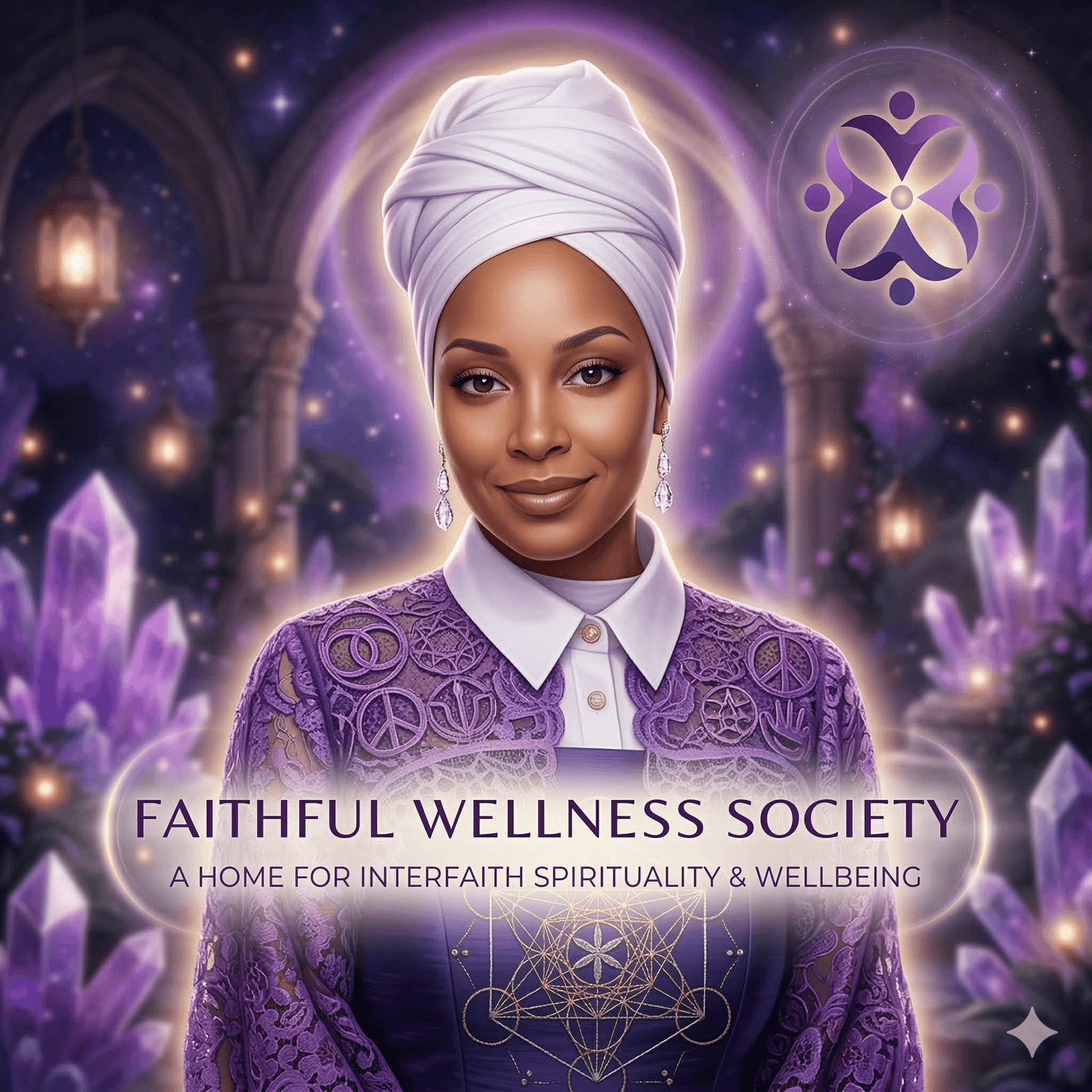
SHALOM — Peace be with you. I am Amina Warner Carter.
Interfaith Minister, Spiritual Life Coach, Biblical Educator, Trauma-informed Wellness Guide, and Author of The Physics of the Spirit and Relearning Love. I founded the Faithful Wellness Society because I needed exactly this kind of space and could not find it anywhere. So I built it instead.
The Society sits at the intersection of ancient faith traditions and modern wellness practice. We are interfaith in scope and biblically rooted in foundation — a Harbor for women who are done surviving the architecture of their lives and ready to build something that actually holds.
I work with women navigating trauma, anxiety, ADHD, financial stress, and the particular weight of being the strong one in every room. I bring both the spiritual foundation and the practical strategy — because real transformation is never just one or the other. It is always the whole woman.
You did not find this page by accident.
The door is open. The table is set. And I am genuinely glad you are here.
JOIN THE MAILING LIST
NEWSLETTER
Subscribe now to get daily updates.
Step into the architecture of your reclamation—where spiritual physics, interfaith healing,
and generational continuity meet. Whether you are unmasking your internal truth or building
a sanctuary for your children’s children, we provide the sacred blueprints and a safe harbor
to help you reclaim your sovereignty and walk in profound, permanent joy.
FOLLOW ME


Created by Tax Plus Marketing LLC | Created with © systeme.io